

 Mexico
 South Korea
 South Africa
 Czechia
 Canada
 Switzerland
 Qatar
Qatar Bosnia & Herz
 Brazil
 Morocco
 Scotland
 Haiti
Haiti USA
USA Paraguay
 Australia
 Türkiye
 Germany
 Ecuador
 Ivory Coast
 Curaçao
 Netherlands
 Japan
Japan Tunisia
 Sweden
 Belgium
 Iran
Iran Egypt
Egypt New Zealand
 Spain
Spain Uruguay
 Saudi Arabia
 Cape Verde
 France
 Senegal
 Norway
 Iraq
Iraq Argentina
 Austria
 Algeria
 Jordan
 Portugal
 Colombia
 Uzbekistan
 DR Congo
 England
 Croatia
 Panama
 Ghana
Ghana
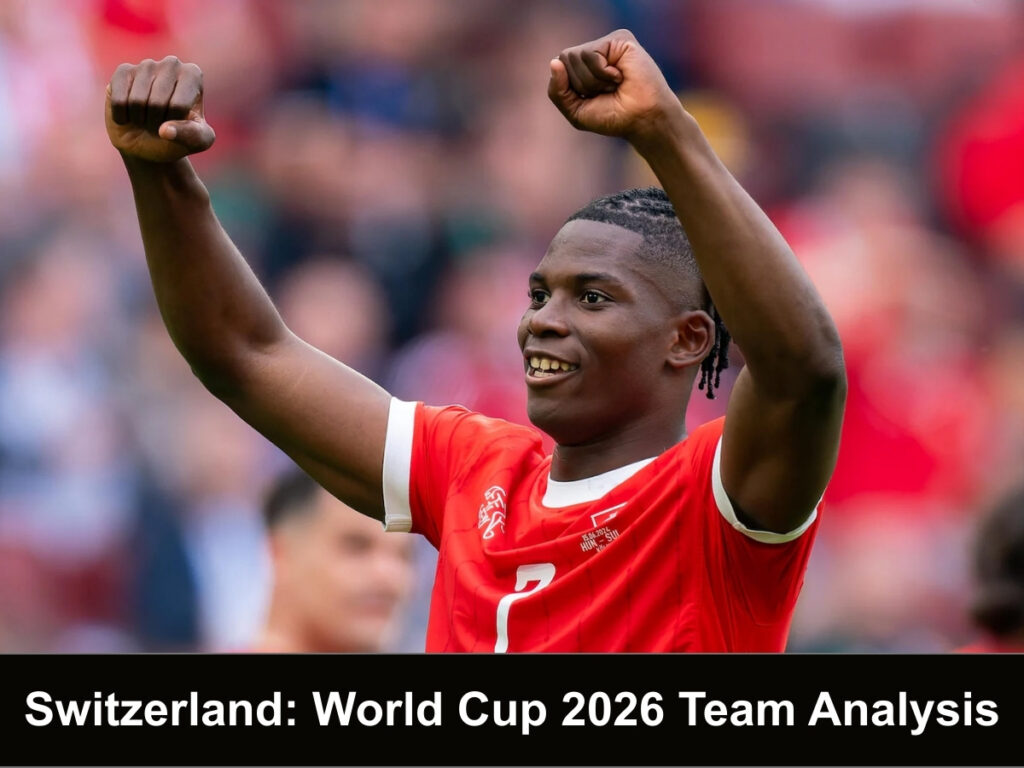
Switzerland 2026 World Cup: Team Analysis, Roster Projection & Preview
Switzerland National Team Preview – 2026 FIFA World Cup
Switzerland enters the 2026 World Cup cycle as one of Europe’s most tactically disciplined and consistently competitive national teams. Known for structured defensive organization and efficient attacking execution, Switzerland has built a reputation for advancing beyond the group stage in major tournaments. With a blend of experienced leaders and technically refined younger players, the Swiss national team remains a formidable opponent on the international stage.
Under head coach Murat Yakin, the Switzerland National Team emphasizes defensive compactness, midfield balance, and efficient transitional play. The squad blends experienced figures such as Granit Xhaka and Ricardo Rodríguez with emerging talents including Dan Ndoye and Fabian Rieder. This combination of composure, physicality, and tactical cohesion positions Switzerland as a strong European contender entering the 2026 World Cup.
Tactical Foundation
Switzerland’s tactical identity centers on structure and efficiency.
- Compact defensive organization – The Swiss maintain disciplined spacing between defensive and midfield lines, limiting central penetration.
- Midfield control – Switzerland relies on technically capable midfielders to regulate tempo and maintain possession under pressure.
- Efficient attacking transitions – The team looks to exploit space quickly through wide channels and direct vertical passes.
- Formation flexibility – Typically operating in a 4-2-3-1 or 3-4-2-1, Switzerland can shift systems depending on opponent quality.
This structured and adaptable approach allows Switzerland to compete effectively against elite European opposition.
Team Performance in the Last Year
Over the past 12–18 months, Switzerland has continued competing strongly in European competition and international fixtures, maintaining defensive stability and structured attacking patterns.
Attack
Switzerland’s attack blends experience with mobility.
- Breel Embolo – Physical striker capable of holding up play and finishing chances.
- Dan Ndoye – Dynamic winger with pace and 1v1 ability.
- Ruben Vargas – Creative wide attacker contributing goals and assists.
- Fabian Rieder – Technical midfielder with attacking influence.
- Noah Okafor – Versatile forward providing speed and movement.
Switzerland’s attacking patterns emphasize:
- Wide progression and crossing
- Quick midfield combinations
- Set-piece opportunities
- Structured counterattacks
Defense
Defensively, Switzerland combines experience and positional intelligence.
- Manuel Akanji – Central defensive leader with composure and ball progression ability.
- Nico Elvedi – Reliable center-back with positional awareness.
- Ricardo Rodríguez – Experienced left-back offering balance and set-piece delivery.
- Silvan Widmer – Energetic right-back with defensive reliability.
Goalkeeper Gregor Kobel has emerged as a strong option, offering elite reflexes and modern distribution skills.
Overall, Switzerland enters the 2026 cycle with tactical cohesion and consistent tournament pedigree.
Expected 2026 Switzerland World Cup Roster
Goalkeepers
Gregor Kobel – Likely starter with elite shot-stopping ability.
Yann Sommer – Veteran presence and tournament experience.
Jonas Omlin – Reliable depth goalkeeper.
Defenders
Manuel Akanji – Defensive anchor.
Nico Elvedi – Composed central defender.
Ricardo Rodríguez – Experienced left-back.
Silvan Widmer – Balanced right-back.
Cédric Zesiger – Defensive depth option.
Fabian Schär – Experienced center-back.
Eray Cömert – Rotational defensive presence.
Midfielders
Granit Xhaka – Midfield leader and tempo controller.
Remo Freuler – Defensive midfield stabilizer.
Fabian Rieder – Creative central option.
Denis Zakaria – Physical box-to-box contributor.
Ardon Jashari – Emerging midfield talent.
Michel Aebischer – Versatile midfield depth.
Forwards / Attackers
Breel Embolo – Primary striker option.
Dan Ndoye – Explosive wide attacker.
Ruben Vargas – Technical winger.
Noah Okafor – Versatile forward.
Zeki Amdouni – Finishing-oriented striker.
Steven Zuber – Experienced attacking depth.
This projected roster reflects Switzerland’s blend of defensive organization and attacking versatility.
Players to Watch
Granit Xhaka
Midfield leader whose composure and distribution define Switzerland’s tempo.
Manuel Akanji
Defensive anchor providing stability and ball progression.
Breel Embolo
Physical striker capable of decisive tournament moments.
Gregor Kobel
Emerging goalkeeper with elite reflexes and composure.
Dan Ndoye
Dynamic winger bringing pace and unpredictability.
Projected Starting XI
Formation: 4-2-3-1
GK: Gregor Kobel
RB: Silvan Widmer
CB: Manuel Akanji
CB: Nico Elvedi
LB: Ricardo Rodríguez
DM: Granit Xhaka
CM: Remo Freuler
RW: Dan Ndoye
CAM: Fabian Rieder
LW: Ruben Vargas
ST: Breel Embolo
Switzerland can also shift into a 3-4-2-1 when emphasizing defensive solidity.
Strengths and Weaknesses
Attack
Strengths: Efficient transitions; set-piece quality; physical striker presence.
Weaknesses: Creative consistency against compact defenses.
Midfield
Strengths: Tactical discipline; tempo control; physical balance.
Weaknesses: Sustained possession dominance against elite sides.
Defense
Strengths: Organized shape; experienced center-backs.
Weaknesses: Exposure to rapid wing rotations.
Goalkeeping
Strengths: Elite reflexes; composure.
Weaknesses: Distribution under aggressive pressing.
Tactics
Strengths: Formation adaptability; defensive cohesion.
Weaknesses: Breaking down deep defensive blocks.
Mentality
Strengths: Tournament resilience; disciplined team structure.
Weaknesses: Converting strong group-stage performances into deeper knockout success.
Switzerland Injury Report Ahead of the 2026 World Cup
Switzerland’s overall injury picture remains relatively stable entering the 2026 World Cup cycle, but several important players have dealt with fitness concerns during recent club and international periods. Compared with some other European contenders, the Swiss are not facing a major injury crisis, though a few key names continue to require monitoring.
| Player | Position | Injury | Status |
|---|---|---|---|
| Breel Embolo | Striker | Recent fitness management | Available / monitored |
| Denis Zakaria | Defensive Midfielder | Groin / adductor issue | Managed workload |
| Noah Okafor | Forward / Winger | Hamstring / muscular issue | Monitoring return |
| Nico Elvedi | Center Back | Minor recent fitness concerns | Available |
| Silvan Widmer | Right Back | No major current issue | Available |
| Ricardo Rodríguez | Left Back | No major current issue | Available |
Breel Embolo
Embolo remains one of Switzerland’s most important attacking players because of his physical presence, hold-up play, and ability to lead the line. While he does not currently appear to be dealing with a major fresh long-term setback, his fitness has still been watched carefully as Switzerland builds toward 2026.
Denis Zakaria
Zakaria has been one of the clearest recent injury concerns in the Swiss pool. He dealt with an adductor injury earlier in the 2025–26 season and has also recently been linked with renewed groin discomfort. When healthy, he gives Switzerland physicality, ball-winning ability, and tactical flexibility in midfield.
Noah Okafor
Okafor has recently been managing a hamstring and muscular issue that interrupted his club availability. Because of his pace and directness, Switzerland will want him fully fit as an impact option heading into major tournament preparation.
Defensive Unit
At the moment, Switzerland’s defensive group appears to be in a more stable place than the attack and midfield. Players such as Nico Elvedi, Silvan Widmer, and Ricardo Rodríguez do not appear to be carrying the same level of current injury concern as some of the more monitored attacking pieces.
Overall, Switzerland’s projected core remains largely available entering the 2026 cycle. The biggest focus will be managing workloads across European club competitions and keeping key transition players healthy ahead of tournament camp.
Historical World Cup Performance
Switzerland’s World Cup history includes:
- Multiple Round-of-16 appearances
- Consistent qualification in the modern era
- Strong defensive tournament identity
Their football philosophy has historically emphasized:
- Defensive discipline
- Structured tactical play
- Competitive resilience
Outlook for the 2026 World Cup
Switzerland enters the 2026 World Cup with tactical cohesion, experienced leadership, and efficient attacking structure. With Granit Xhaka anchoring midfield and a disciplined defensive core led by Manuel Akanji, the Swiss possess the tools to compete effectively in any group.
Group Stage Outlook: Switzerland is capable of advancing from a competitive group.
Knockout-Stage Potential: A Round-of-16 appearance is realistic, with quarterfinal ambitions dependent on clinical finishing and defensive stability.