

 Mexico
 South Korea
 South Africa
 Czechia
 Canada
 Switzerland
 Qatar
Qatar Bosnia & Herz
 Brazil
 Morocco
 Scotland
 Haiti
Haiti USA
USA Paraguay
 Australia
 Türkiye
 Germany
 Ecuador
 Ivory Coast
 Curaçao
 Netherlands
 Japan
Japan Tunisia
 Sweden
 Belgium
 Iran
Iran Egypt
Egypt New Zealand
 Spain
Spain Uruguay
 Saudi Arabia
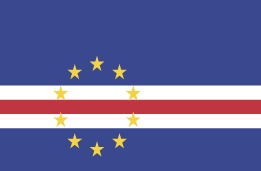 Cape Verde
 France
 Senegal
 Norway
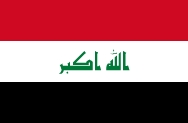 Iraq
Iraq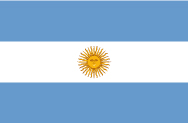 Argentina
 Austria
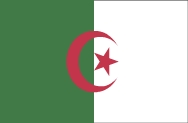 Algeria
 Jordan
 Portugal
 Colombia
 Uzbekistan
 DR Congo
 England
 Croatia
 Panama
 Ghana
Ghana
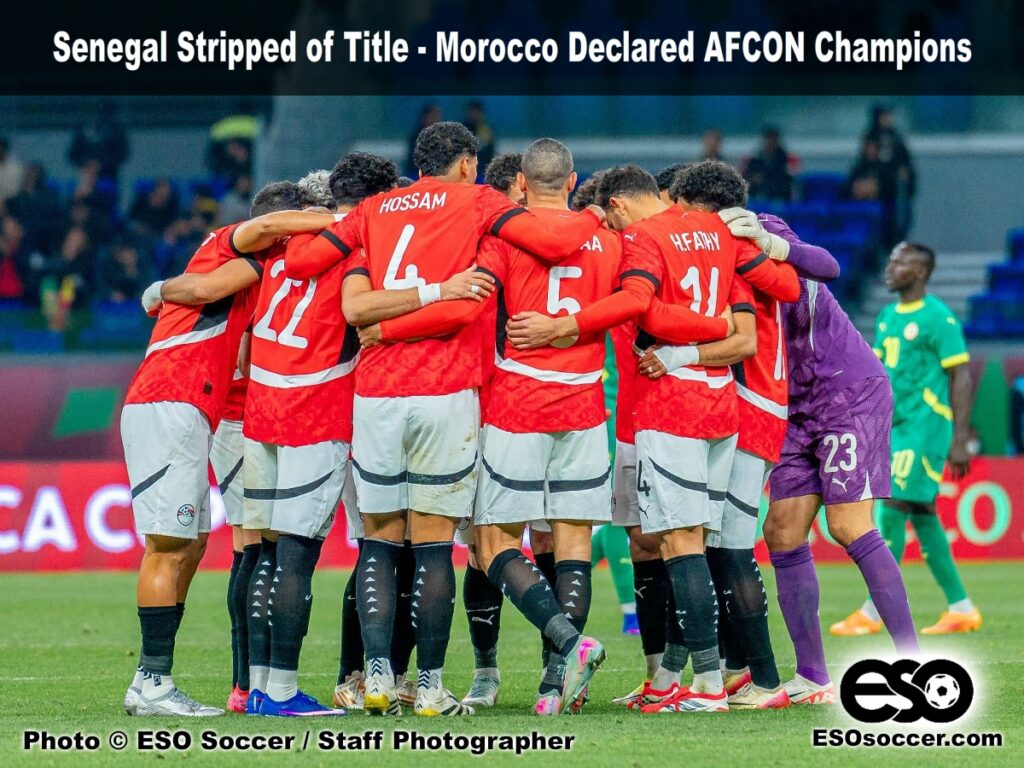
Senegal Stripped of AFCON Title as Morocco Declared Champions After Controversial CAF Decision
“As emotions boiled over, the situation escalated beyond the players. Fans rushed toward the field, objects were thrown, and clashes broke out with security, creating a volatile and dangerous atmosphere in Rabat. Given the circumstances, there is a strong argument that Senegal’s decision-making was influenced by player safety concerns, and that temporarily leaving the field—or even exiting the grounds—could be viewed as a protective measure rather than purely an act of protest.” ~ Reported by an ESO Soccer journalist, who was on-location for the AFCON Championship Match.
In one of the most controversial developments in recent African football history, Senegal have reportedly been stripped of their Africa Cup of Nations title, with Morocco declared champions following a ruling by the Confederation of African Football (CAF)
The dramatic decision has sent shockwaves across the football world and sparked fierce debate among supporters, pundits, and national federations. What had originally been remembered as a hard-fought AFCON final between two major African powers has now become a case study in how disciplinary regulations can override the result on the pitch.
What Happened in the AFCON Final?
The controversy stems from the AFCON final played in Rabat on January 18, where Senegal had initially emerged as 1-0 winners after extra time. The match was tense throughout and remained scoreless deep into stoppage time of normal play. Then came the moment that changed everything.
Morocco were awarded a late penalty following a VAR review for a challenge on Brahim Diaz. The decision immediately triggered a furious reaction from Senegal’s players, several of whom walked off the field in protest. The match was halted for nearly 20 minutes during the chaotic scenes, with officials, team representatives, and players trying to restore order.
Eventually, Senegal captain Sadio Mane helped coax his teammates back onto the pitch, and the game resumed. Morocco then failed to convert the penalty, with goalkeeper Edouard Mendy saving the attempt. In extra time, Pape Gueye scored what appeared to be the winning goal for Senegal, sealing a 1-0 victory and what seemed to be another major title for the West African nation.
CAF Overturns the Result
That result, however, did not stand.
After reviewing Morocco’s appeal, CAF ruled that Senegal had forfeited the match by leaving the field before the regulation end of play without authorization from the referee. As a result, the governing body officially recorded the game as a 3-0 victory for Morocco and declared the Atlas Lions AFCON champions.
The decision was based on Articles 82 and 84 of the AFCON Regulations, which reportedly state that if a team refuses to play or leaves the ground before the regular end of the match without authorization, that team can be considered the loser and may forfeit the match by a 3-0 scoreline.
Why the Ruling Matters
The ruling is significant because it highlights the power of tournament regulations in modern football. Even though Senegal returned to the pitch and went on to win the match on the field, CAF determined that the earlier walk-off itself was enough to justify disciplinary action.
This means the final outcome was decided not purely by footballing events, but by the competition’s legal and regulatory framework. For some observers, that is an important statement about maintaining order, authority, and respect for officials in major tournaments. For others, it is a harsh and overly rigid decision that punishes an emotional reaction in a high-pressure moment.
Either way, the ruling is likely to be remembered for years as one of the most controversial administrative decisions in African football.
Morocco’s Position
The Royal Moroccan Football Federation reportedly said its appeal was never intended to challenge the sporting quality or effort of the teams involved, but rather to seek proper enforcement of the competition’s rules. Morocco’s position appears to be that the regulations were clear and that CAF simply applied them as written.
From Morocco’s perspective, the issue was not whether Senegal played well enough to win, but whether the laws governing the match had been violated. CAF agreed with that argument, and the result now stands in Morocco’s favor unless it is overturned on further appeal.
Senegal’s Response and Possible Appeal
Senegal’s football federation did not immediately issue a detailed official response in the aftermath of the ruling, but the reaction among players and supporters has been emotional. Some players took to social media to express disbelief and frustration, suggesting that the team still sees itself as the rightful champion based on what happened on the pitch.
According to the report, Senegal can appeal the CAF Appeals Committee decision to the Court of Arbitration for Sport within 10 days. If that happens, the case could become one of the biggest legal disputes in recent African football.
An appeal to CAS would likely focus on whether the punishment was proportionate, whether the circumstances of the incident were properly evaluated, and whether the return to the field should have altered the interpretation of the rules.
Chaotic Scenes and Wider Fallout
The final was already marred by disorder before the ruling was handed down. Reports indicated that some Senegal supporters attempted a pitch invasion, while tempers flared among players and officials during the stoppage. FIFA President Gianni Infantino, who attended the match, reportedly condemned the scenes and said such conduct was unacceptable in football.
CAF had already imposed disciplinary sanctions and fines on both federations in the aftermath of the final for unsportsmanlike conduct and violations of fair play principles. That context only added to the seriousness of the case and likely influenced how closely the governing body reviewed Morocco’s complaint.
What This Means for African Football
This episode raises major questions about officiating, player conduct, tournament governance, and the balance between sporting justice and administrative enforcement. Should a match result be overturned after a team returns and completes the game? Should emotional protests in controversial moments automatically trigger a forfeit? And how much discretion should governing bodies have in interpreting such incidents?
For African football, the ruling sends a strong message that disciplinary regulations will be enforced even in the biggest matches. For players and coaches, it is also a warning that leaving the field in protest can have enormous consequences, regardless of what happens once play resumes.
Final Thoughts
The AFCON final between Senegal and Morocco was already dramatic on the pitch, but CAF’s decision has transformed it into something even bigger: a football controversy that now sits at the intersection of sport, law, and governance.
Senegal may feel they won the trophy where it matters most — on the field. But under CAF’s interpretation of the rules, Morocco are now the official champions. Unless an appeal changes that outcome, this will go down as one of the most astonishing title reversals in the history of African football.