

 Mexico
 South Korea
 South Africa
 TBD
TBD Canada
 Switzerland
 Qatar
Qatar Brazil
 Morocco
 Scotland
 Haiti
Haiti USA
USA Paraguay
 Australia
 Germany
 Ecuador
 Ivory Coast
 Curaçao
 Netherlands
 Japan
Japan Tunisia
 Belgium
 Iran
Iran Egypt
Egypt New Zealand
 Spain
Spain Uruguay
 Saudi Arabia
 Cape Verde
 France
 Senegal
 Norway
 Argentina
 Austria
 Algeria
 Jordan
 Portugal
 Colombia
 Uzbekistan
 England
 Croatia
 Panama
 Ghana
Ghana

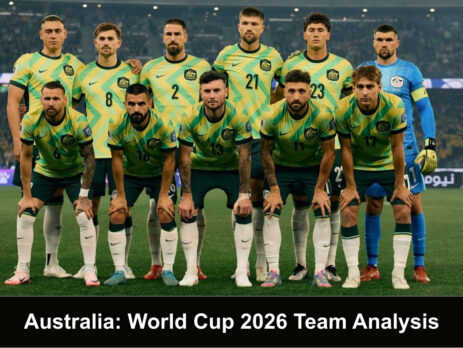
Australia 2026 World Cup: Team Analysis, Roster Projection & Preview
Australia enters the 2026 World Cup cycle as one of Asia’s most resilient and tactically disciplined national teams. Known as the Socceroos, Australia has built a reputation for physical intensity, defensive organization, and strong tournament mentality. After reaching the Round of 16 in 2022, the team continues to evolve with a new generation of technically capable players emerging across European leagues. With consistent AFC qualification success and growing depth, Australia remains one of the region’s strongest contenders heading toward 2026.
Under head coach Graham Arnold (or confirmed successor ahead of 2026), The Australia National Team emphasizes structured defensive shape, midfield work rate, and direct attacking transitions. The squad blends experienced leaders such as Mathew Ryan and Jackson Irvine with emerging talents including Garang Kuol and Connor Metcalfe. This balance of physicality, tactical cohesion, and youthful energy positions Australia as a competitive force in the expanded 2026 tournament.
Tactical Foundation
Australia’s tactical identity centers on defensive organization and transitional efficiency.
Compact defensive structure – The Socceroos maintain disciplined defensive lines, minimizing space between midfield and defense.
Midfield intensity – Physical ball recovery and work rate are central to Australia’s ability to disrupt opponents.
Direct vertical play – Australia frequently looks to progress the ball quickly through wide channels and early crosses.
Formation flexibility – Typically operating in a 4-3-3 or 4-2-3-1, Australia can shift into a more compact 4-4-2 when protecting a result.
This approach allows Australia to compete effectively against both technically advanced and physically dominant opponents.
Team Performance in the Last Year
Over the past 12–18 months, Australia has continued to compete strongly in AFC competition and international friendlies, building on defensive resilience and structured attacking transitions.
Attack
Australia’s attack blends pace and physical presence.
Mitchell Duke – Hard-working striker capable of holding up play and finishing chances.
Jamie Maclaren – Clinical goal scorer with strong movement in the box.
Garang Kuol – Emerging winger with pace and dribbling ability.
Connor Metcalfe – Midfield attacker contributing energy and creativity.
Awer Mabil – Direct wide presence with crossing threat.
Australia’s attacking patterns emphasize:
Early crosses into the penalty area
Quick transitions after turnovers
Midfield runners supporting forwards
Set-piece opportunities
Defense
Defensively, Australia remains structured and physical.
Harry Souttar – Towering center-back with aerial dominance.
Kye Rowles – Composed defensive presence.
Aziz Behich – Experienced left-back with balanced defensive awareness.
Nathaniel Atkinson – Energetic right-back providing width and recovery speed.
Goalkeeper Mathew Ryan continues to provide leadership and reliability, with extensive tournament experience anchoring the defensive unit.
Overall, Australia enters the 2026 cycle with defensive stability and growing attacking depth.
Expected 2026 Australia World Cup Roster
Goalkeepers
Mathew Ryan – Established No. 1 with major tournament experience. Joe Gauci – Emerging goalkeeper option. Andrew Redmayne – Experienced depth presence.
Defenders
Harry Souttar – Defensive anchor and aerial threat. Kye Rowles – Central defensive partner. Aziz Behich – Reliable left-back. Nathaniel Atkinson – Balanced right-back. Milos Degenek – Experienced defensive depth. Fran Karačić – Wide defensive alternative. Thomas Deng – Rotational center-back.
Midfielders
Jackson Irvine – Midfield leader with work rate and goal threat. Ajdin Hrustic – Creative playmaker with technical ability. Connor Metcalfe – Energetic box-to-box contributor. Awer Mabil – Wide midfield presence. Keanu Baccus – Defensive midfield stabilizer. Riley McGree – Attacking midfield option.
Forwards / Attackers
Mitchell Duke – Hard-working central striker. Jamie Maclaren – Clinical finisher. Garang Kuol – Explosive young winger. Craig Goodwin – Experienced wide attacker. Brandon Borrello – Versatile forward option. Adam Taggart – Rotational striker depth.
This projected roster reflects Australia’s blend of defensive resilience and growing attacking promise.
Players to Watch
Harry Souttar
Defensive cornerstone whose aerial dominance anchors Australia’s structure.
Mathew Ryan
Experienced goalkeeper providing leadership and composure.
Garang Kuol
Emerging winger capable of adding unpredictability and pace.
Jackson Irvine
Midfield leader contributing both defensively and offensively.
Ajdin Hrustic
Creative playmaker responsible for unlocking defenses.
Projected Starting XI
Formation: 4-3-3
GK: Mathew Ryan
RB: Nathaniel Atkinson
CB: Harry Souttar
CB: Kye Rowles
LB: Aziz Behich
CM: Keanu Baccus
CM: Jackson Irvine
CM: Ajdin Hrustic
RW: Garang Kuol
LW: Awer Mabil
ST: Mitchell Duke
Australia can also shift into a 4-4-2 when emphasizing defensive stability and aerial play.
Strengths and Weaknesses
Attack – Strengths: Physical presence; wide pace; set-piece threat. Weaknesses: Creative consistency against elite defenses.
Midfield – Strengths: High work rate; defensive discipline. Weaknesses: Sustained possession control under heavy pressure.
Defense – Strengths: Aerial dominance; compact structure. Weaknesses: Vulnerable to rapid technical attackers.
Goalkeeping – Strengths: Experienced leadership; reliable shot-stopping. Weaknesses: Distribution under aggressive pressing.
Tactics – Strengths: Structured defensive system; transition efficiency. Weaknesses: Breaking down compact opponents.
Mentality – Strengths: Tournament resilience; strong team cohesion. Weaknesses: Managing expectations in knockout stages.
Player Injury Status
Australia’s projected core remains largely available entering the 2026 cycle. Managing European-based player workloads will be important ahead of tournament preparation.
Historical World Cup Performance
Australia’s World Cup history includes:
Round-of-16 appearances in 2006 and 2022
Multiple AFC qualification successes
Competitive performances against elite nations
Their football identity has historically emphasized:
Physical intensity
Defensive discipline
Resilient tournament mentality
Outlook for the 2026 World Cup
Australia enters the 2026 World Cup cycle with structured discipline, physical resilience, and growing technical depth. With Harry Souttar anchoring the defense and a balanced midfield supporting quick transitions, the Socceroos possess the foundation to compete effectively within Asia and on the global stage.
Group Stage Outlook: Australia is capable of competing strongly in a balanced group.
Knockout-Stage Potential: A Round-of-16 appearance is realistic, with further ambitions dependent on defensive stability and clinical finishing.