

 Mexico
 South Korea
 South Africa
 TBD
TBD Canada
 Switzerland
 Qatar
Qatar Brazil
 Morocco
 Scotland
 Haiti
Haiti USA
USA Paraguay
 Australia
 Germany
 Ecuador
 Ivory Coast
 Curaçao
 Netherlands
 Japan
Japan Tunisia
 Belgium
 Iran
Iran Egypt
Egypt New Zealand
 Spain
Spain Uruguay
 Saudi Arabia
 Cape Verde
 France
 Senegal
 Norway
 Argentina
 Austria
 Algeria
 Jordan
 Portugal
 Colombia
 Uzbekistan
 England
 Croatia
 Panama
 Ghana
Ghana

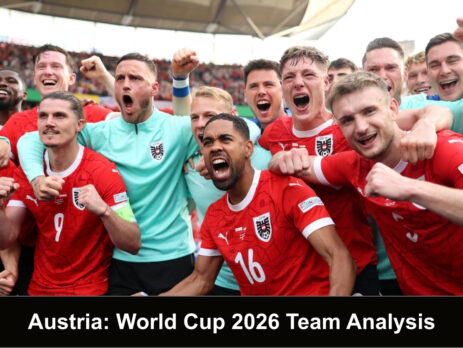
Austria 2026 World Cup: Team Analysis, Roster Projection & Preview
Austria enters the 2026 World Cup cycle as one of Europe’s most tactically organized and rapidly improving national teams. In recent international tournaments and UEFA competition, Austria has demonstrated disciplined structure, high pressing intensity, and technical midfield quality. With a blend of experienced Bundesliga and Premier League performers alongside emerging talents, Das Team continues to build toward consistent competitiveness on the global stage.
Under head coach Ralf Rangnick, The Austria National Team has adopted a high-energy tactical identity built around pressing structure, vertical transitions, and positional intelligence. The squad combines experienced leaders such as David Alaba and Marko Arnautović with dynamic midfielders like Konrad Laimer and Marcel Sabitzer. This balance of veteran composure and athletic intensity positions Austria as a disciplined and difficult opponent heading into the 2026 World Cup.
Tactical Foundation
Austria’s tactical identity reflects Rangnick’s pressing philosophy and structural discipline.
High pressing and counter-pressing – Austria seeks to regain possession quickly through coordinated pressing triggers. Their ability to compress space in midfield makes them disruptive against possession-oriented teams.
Vertical attacking transitions – Once possession is regained, Austria moves the ball forward quickly, utilizing pace and direct passing lanes.
Midfield engine and work rate – The midfield prioritizes mobility and tactical awareness, enabling quick defensive recoveries and forward progression.
Formation flexibility – Austria frequently operates in a 4-2-2-2 or 4-3-3 but can shift into a 4-4-2 pressing shape depending on opponent structure.
This disciplined approach allows Austria to compete effectively against technically superior opponents by controlling tempo through intensity.
Team Performance in the Last Year
Over the past 12–18 months, Austria has continued competing strongly in European competition and international friendlies. The team has demonstrated tactical clarity, collective pressing structure, and balanced attacking contributions.
Attack
Austria’s attack emphasizes mobility and vertical runs.
Marko Arnautović – Experienced forward with physical presence and leadership.
Christoph Baumgartner – Energetic attacking midfielder with goal-scoring instincts.
Marcel Sabitzer – Versatile midfielder capable of long-range strikes and dynamic movement.
Michael Gregoritsch – Reliable central striker option.
Konrad Laimer – Midfield runner contributing both defensively and offensively.
Austria’s attacking patterns emphasize:
Quick forward passing after turnovers
Midfield runners breaking lines
Wide overloads
High pressing leading to direct chances
Defense
Defensively, Austria remains compact and tactically organized.
David Alaba – Defensive leader with versatility and composure.
Gernot Trauner – Central defender providing aerial strength.
Maximilian Wöber – Ball-playing defensive option.
Stefan Lainer – Energetic full-back with pressing support.
Goalkeeper Alexander Schlager has been a consistent presence in recent fixtures, offering strong shot-stopping and reliable command of the penalty area.
Overall, Austria enters the 2026 cycle with structure, pressing intensity, and a cohesive tactical identity.
Expected 2026 Austria World Cup Roster
Goalkeepers
Alexander Schlager – Likely starter with international experience. Patrick Pentz – Reliable depth option. Daniel Bachmann – Experienced alternative with strong reflexes.
Defenders
David Alaba – Defensive anchor and leader. Gernot Trauner – Central defensive presence. Maximilian Wöber – Versatile defender. Stefan Lainer – Dynamic right-back. Philipp Mwene – Balanced full-back option. Kevin Danso – Physical center-back with aerial ability. Phillipp Lienhart – Rotational defensive depth.
Midfielders
Marcel Sabitzer – Creative and versatile midfielder. Konrad Laimer – High-work-rate engine. Christoph Baumgartner – Attacking presence between lines. Florian Grillitsch – Deep-lying playmaker. Nicolas Seiwald – Young midfield option with technical quality. Romano Schmid – Wide creative contributor.
Forwards / Attackers
Marko Arnautović – Experienced striker and leader. Michael Gregoritsch – Central finishing option. Karim Onisiwo – Direct wide attacker. Patrick Wimmer – Pace and energy on the wing. Junior Adamu – Emerging forward talent. Christoph Baumgartner – Hybrid attacking role capability.
This projected roster reflects Austria’s blend of pressing intensity, Bundesliga experience, and tactical cohesion.
Players to Watch
David Alaba
The experienced defensive leader whose versatility strengthens Austria’s structure.
Marcel Sabitzer
Creative midfielder capable of influencing matches through both scoring and playmaking.
Christoph Baumgartner
Energetic attacker who thrives in high-tempo pressing systems.
Konrad Laimer
Midfield engine whose work rate fuels Austria’s tactical approach.
Marko Arnautović
Veteran forward providing leadership and physical presence in decisive moments.
Projected Starting XI
Formation: 4-2-2-2
GK: Alexander Schlager
RB: Stefan Lainer
CB: David Alaba
CB: Gernot Trauner
LB: Philipp Mwene
DM: Konrad Laimer
CM: Marcel Sabitzer
RM: Christoph Baumgartner
LM: Romano Schmid
ST: Marko Arnautović
ST: Michael Gregoritsch
Austria can also transition into a 4-3-3 when emphasizing midfield control.
Strengths and Weaknesses
Attack – Strengths: Vertical pace; midfield runners; pressing-generated chances. Weaknesses: Limited elite finishing depth.
Midfield – Strengths: High work rate; tactical intelligence; pressing cohesion. Weaknesses: Can struggle against deep defensive blocks.
Defense – Strengths: Organized shape; versatile leadership in Alaba. Weaknesses: Vulnerable against high-speed counterattacks.
Goalkeeping – Strengths: Reliable shot-stopping. Weaknesses: Distribution under heavy press.
Tactics – Strengths: Coordinated pressing; structured transitions. Weaknesses: Maintaining energy levels across tournament schedule.
Mentality – Strengths: Cohesive and disciplined. Weaknesses: Limited recent deep World Cup experience.
Player Injury Status
Austria’s projected core remains largely available entering the 2026 cycle. As with most European squads, managing club workloads will be essential ahead of tournament preparation. Depth across midfield provides flexibility should injuries arise.
Historical World Cup Performance
Austria’s World Cup history includes:
Third place in 1954
Multiple early-era quarterfinal appearances
Periodic qualification in the modern era
Their football identity has long emphasized:
Technical midfield quality
Structured defensive discipline
European tactical sophistication
Outlook for the 2026 World Cup
Austria enters the 2026 World Cup cycle as a tactically disciplined and high-energy team capable of challenging strong opposition. With David Alaba anchoring the defense and a pressing-driven midfield core supporting vertical transitions, Austria possesses the structure to compete effectively.
Group Stage Outlook: Austria can compete in a balanced group and has realistic advancement ambitions.
Knockout-Stage Potential: A Round-of-16 appearance is achievable, with further progression dependent on tactical execution and squad health.