

 Mexico
 South Korea
 South Africa
 TBD
TBD Canada
 Switzerland
 Qatar
Qatar Brazil
 Morocco
 Scotland
 Haiti
Haiti USA
USA Paraguay
 Australia
 Germany
 Ecuador
 Ivory Coast
 Curaçao
 Netherlands
 Japan
Japan Tunisia
 Belgium
 Iran
Iran Egypt
Egypt New Zealand
 Spain
Spain Uruguay
 Saudi Arabia
 Cape Verde
 France
 Senegal
 Norway
 Argentina
 Austria
 Algeria
 Jordan
 Portugal
 Colombia
 Uzbekistan
 England
 Croatia
 Panama
 Ghana
Ghana

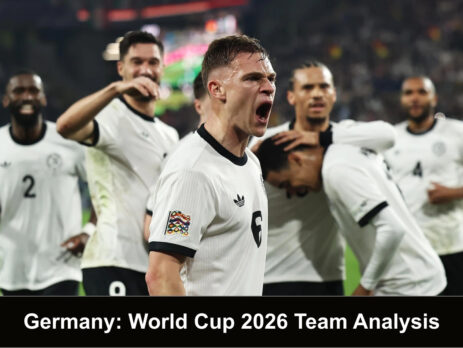
Germany 2026 World Cup: Team Analysis, Roster Projection & Preview
Germany enters the 2026 World Cup cycle as one of international football’s most historically dominant and tactically refined national teams. A four-time World Cup champion, Germany remains a global powerhouse despite undergoing a generational transition in recent tournaments. With a renewed focus on midfield control, defensive structure, and attacking versatility, Die Mannschaft aims to reassert itself among the elite on football’s biggest stage.
Under head coach Julian Nagelsmann, The Germany National Team has emphasized high pressing, positional fluidity, and tactical adaptability. The squad blends experienced leaders such as Joshua Kimmich and Ilkay Gündogan with emerging stars including Jamal Musiala and Florian Wirtz. This combination of technical creativity and structured discipline positions Germany as a serious contender heading into the 2026 World Cup.
Tactical Foundation
Germany’s tactical identity balances structure with attacking dynamism.
Midfield intelligence – Germany relies on technically strong midfielders to dictate tempo and control possession under pressure.
High pressing – Coordinated pressing sequences aim to regain possession quickly in advanced areas.
Wide attacking flexibility – The team uses dynamic wingers and overlapping full-backs to stretch defensive lines.
Formation adaptability – Typically operating in a 4-2-3-1 or 4-3-3, Germany can shift into a back-three system depending on opponent strength.
This tactical flexibility allows Germany to adapt to various match scenarios and competitive environments.
Team Performance in the Last Year
Over the past 12–18 months, Germany has focused on rebuilding consistency following recent tournament transitions. The team has shown improved balance between experienced leadership and emerging youth.
Attack
Germany’s attack blends technical precision with youthful creativity.
Jamal Musiala – Dynamic attacking midfielder capable of unlocking defenses.
Florian Wirtz – Creative playmaker with vision and goal-scoring threat.
Niclas Füllkrug – Physical striker providing finishing and aerial presence.
Leroy Sané – Pace-driven winger with direct attacking threat.
Kai Havertz – Versatile forward contributing both creativity and scoring.
Germany’s attacking patterns emphasize:
Quick combination play
Wide overloads
Late midfield runs
High pressing leading to turnovers
Defense
Defensively, Germany blends youth and experience.
Antonio Rüdiger – Defensive leader with physical presence and composure.
Nico Schlotterbeck – Ball-playing center-back option.
Joshua Kimmich – Versatile defender/midfielder with tactical intelligence.
David Raum – Attack-minded left-back providing width.
Goalkeeper Marc-André ter Stegen has established himself as Germany’s primary option, offering elite reflexes and distribution.
Overall, Germany enters the 2026 cycle with renewed tactical clarity and technical depth.
Expected 2026 Germany World Cup Roster
Goalkeepers
Marc-André ter Stegen – Established No. 1 with elite distribution. Manuel Neuer – Veteran presence and tournament experience. Oliver Baumann – Reliable depth option.
Defenders
Antonio Rüdiger – Defensive anchor and leader. Nico Schlotterbeck – Composed central defender. Jonathan Tah – Physical center-back option. Joshua Kimmich – Versatile right-back/midfield role. David Raum – Balanced left-back. Benjamin Henrichs – Defensive depth option. Robin Koch – Rotational central defender.
Midfielders
Ilkay Gündogan – Experienced midfield leader. Jamal Musiala – Creative attacking force. Florian Wirtz – Technical playmaker. Leon Goretzka – Physical box-to-box presence. Pascal Groß – Tactical depth option. Emre Can – Defensive midfield versatility.
Forwards / Attackers
Niclas Füllkrug – Primary striker option. Leroy Sané – Explosive wide attacker. Kai Havertz – Versatile forward. Serge Gnabry – Direct scoring threat. Julian Brandt – Creative attacking depth. Thomas Müller – Experienced attacking presence (selection dependent).
This projected roster reflects Germany’s blend of technical creativity and tournament experience.
Players to Watch
Jamal Musiala
Creative engine capable of decisive individual brilliance.
Antonio Rüdiger
Defensive leader anchoring the back line.
Florian Wirtz
Emerging playmaker with elite vision and composure.
Marc-André ter Stegen
Goalkeeper providing reliability and elite distribution.
Joshua Kimmich
Tactical leader capable of influencing multiple phases of play.
Projected Starting XI
Formation: 4-2-3-1
GK: Marc-André ter Stegen
RB: Joshua Kimmich
CB: Antonio Rüdiger
CB: Nico Schlotterbeck
LB: David Raum
DM: Ilkay Gündogan
CM: Leon Goretzka
RW: Leroy Sané
CAM: Jamal Musiala
LW: Florian Wirtz
ST: Niclas Füllkrug
Germany can also transition into a 4-3-3 when emphasizing midfield control.
Strengths and Weaknesses
Attack – Strengths: Technical creativity; wide explosiveness; pressing intensity. Weaknesses: Consistency in finishing under pressure.
Midfield – Strengths: Tactical intelligence; possession control; depth. Weaknesses: Physical transitions against elite counterattacks.
Defense – Strengths: Experienced center-backs; structured buildup. Weaknesses: Vulnerability to rapid transitions.
Goalkeeping – Strengths: Elite reflexes; distribution quality. Weaknesses: Limited margin for error against high-pressing opponents.
Tactics – Strengths: Formation flexibility; coordinated pressing. Weaknesses: Managing tempo against compact defensive blocks.
Mentality – Strengths: Strong tournament pedigree; competitive resilience. Weaknesses: Managing generational transition expectations.
Player Injury Status
Germany’s projected core remains largely available entering the 2026 cycle. Managing workload for key midfield and attacking players will be essential ahead of tournament preparation.
Historical World Cup Performance
Germany’s World Cup history includes:
Champions in 1954, 1974, 1990, and 2014
Multiple semifinal and final appearances
Consistent knockout-stage pedigree
Their football identity has historically emphasized:
Tactical discipline
Midfield control
Structured attacking balance
Outlook for the 2026 World Cup
Germany enters the 2026 World Cup with renewed tactical clarity, elite technical depth, and experienced leadership. With Jamal Musiala driving attacking creativity and Antonio Rüdiger anchoring defense, Die Mannschaft possesses the tools to compete at the highest level.
Group Stage Outlook: Germany should be competitive in any group and positioned to advance.
Knockout-Stage Potential: A quarterfinal appearance is realistic, with semifinal ambitions dependent on defensive stability and consistent finishing.