

 Mexico
 South Korea
 South Africa
 TBD
TBD Canada
 Switzerland
 Qatar
Qatar Brazil
 Morocco
 Scotland
 Haiti
Haiti USA
USA Paraguay
 Australia
 Germany
 Ecuador
 Ivory Coast
 Curaçao
 Netherlands
 Japan
Japan Tunisia
 Belgium
 Iran
Iran Egypt
Egypt New Zealand
 Spain
Spain Uruguay
 Saudi Arabia
 Cape Verde
 France
 Senegal
 Norway
 Argentina
 Austria
 Algeria
 Jordan
 Portugal
 Colombia
 Uzbekistan
 England
 Croatia
 Panama
 Ghana
Ghana

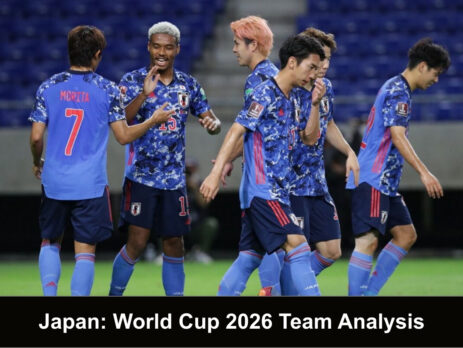
Japan 2026 World Cup: Team Analysis, Roster Projection & Preview
Japan enters the 2026 World Cup as one of Asia’s most technically advanced and tactically disciplined national teams. Known as the Samurai Blue, Japan has built a reputation for structured pressing, technical midfield quality, and fearless performances against elite opposition. After advancing to the Round of 16 in both 2018 and 2022, Japan continues to establish itself as a consistent global competitor. With a strong pipeline of European-based talent, the team combines speed, discipline, and intelligent movement heading into 2026.
Under head coach Hajime Moriyasu, The Japan National Team has emphasized coordinated pressing, rapid transitions, and positional flexibility. The squad blends experienced internationals with emerging stars such as Takefusa Kubo and Kaoru Mitoma, while established leaders like Takumi Minamino and Wataru Endo provide structure. This balance of technical ability and tactical cohesion positions Japan as one of AFC’s strongest contenders.
Tactical Foundation
Japan’s tactical identity centers on pressing intensity and technical precision.
Coordinated high pressing – Japan applies structured pressure immediately after losing possession, often forcing turnovers in advanced areas.
Technical midfield control – Short passing sequences and intelligent off-ball movement allow Japan to maintain possession under pressure.
Wide attacking speed – Pace and dribbling from wide players stretch defenses and create transition opportunities.
Formation flexibility – Typically operating in a 4-3-3 or 4-2-3-1, Japan can shift into a more compact 4-4-2 against stronger opponents.
This structured yet aggressive system enables Japan to compete effectively against both possession-heavy and physically dominant teams.
Team Performance in the Last Year
Over the past 12–18 months, Japan has continued to perform strongly in AFC competition and international friendlies. The team has demonstrated attacking fluidity and defensive organization, building momentum toward 2026.
Attack
Japan’s attack is built on mobility and technical creativity.
Takefusa Kubo – Dynamic winger capable of unlocking defenses with pace and dribbling.
Kaoru Mitoma – Explosive wide attacker with 1v1 ability.
Takumi Minamino – Experienced forward contributing creativity and finishing.
Daichi Kamada – Technical attacking midfielder with goal-scoring presence.
Ayase Ueda – Mobile striker option with strong movement.
Japan’s attacking patterns emphasize:
Quick short-passing combinations
Wide isolation and cut-inside runs
Midfield support arriving late in the box
Pressing-triggered counterattacks
Defense
Defensively, Japan combines discipline with athleticism.
Takehiro Tomiyasu – Versatile defender comfortable centrally or at full-back.
Ko Itakura – Composed center-back with positional awareness.
Yuto Nagatomo – Experienced full-back providing leadership.
Hiroki Ito – Ball-playing defender offering depth.
Goalkeeper Zion Suzuki has emerged as a modern option with strong reflexes and distribution, while veteran options remain available for tournament experience.
Overall, Japan enters the 2026 cycle with structured pressing and dynamic attacking versatility.
Expected 2026 Japan World Cup Roster
Goalkeepers
Zion Suzuki – Emerging first-choice goalkeeper. Shuichi Gonda – Experienced tournament option. Daniel Schmidt – Reliable depth goalkeeper.
Defenders
Takehiro Tomiyasu – Defensive leader and versatile presence. Ko Itakura – Central defensive anchor. Hiroki Ito – Ball-playing defender. Yuto Nagatomo – Veteran full-back. Yukinari Sugawara – Dynamic right-back. Shogo Taniguchi – Experienced central defender. Ayumu Seko – Emerging defensive depth.
Midfielders
Wataru Endo – Defensive midfield anchor. Daichi Kamada – Creative attacking midfielder. Ao Tanaka – Box-to-box presence. Hidemasa Morita – Tactical midfield stabilizer. Reo Hatate – Energetic central option. Takumi Minamino – Hybrid attacking-midfield role.
Forwards / Attackers
Takefusa Kubo – Creative wide attacker. Kaoru Mitoma – Pace-driven winger. Ayase Ueda – Central striker option. Daizen Maeda – High-energy forward with pressing ability. Ritsu Doan – Versatile attacking presence. Takuma Asano – Experienced forward depth.
This projected roster reflects Japan’s blend of European-based experience, tactical discipline, and youthful energy.
Players to Watch
Takefusa Kubo
Creative winger whose dribbling and pace add unpredictability.
Kaoru Mitoma
Explosive wide attacker capable of decisive moments.
Wataru Endo
Midfield anchor responsible for defensive balance.
Takehiro Tomiyasu
Versatile defender whose composure supports structured buildup.
Zion Suzuki
Goalkeeper whose reflexes and distribution modernize Japan’s defensive approach.
Projected Starting XI
Formation: 4-3-3
GK: Zion Suzuki
RB: Yukinari Sugawara
CB: Takehiro Tomiyasu
CB: Ko Itakura
LB: Hiroki Ito
CM: Wataru Endo
CM: Ao Tanaka
CM: Daichi Kamada
RW: Takefusa Kubo
LW: Kaoru Mitoma
ST: Ayase Ueda
Japan can also transition into a 4-2-3-1 when emphasizing pressing stability.
Strengths and Weaknesses
Attack – Strengths: Wide speed; technical creativity; pressing-generated chances. Weaknesses: Finishing consistency in tight matches.
Midfield – Strengths: Tactical discipline; tempo control; high work rate. Weaknesses: Physical matchups against elite midfields.
Defense – Strengths: Structured shape; positional intelligence. Weaknesses: Vulnerable to aerial dominance.
Goalkeeping – Strengths: Strong reflexes; improving distribution. Weaknesses: Limited margin for error against elite finishing.
Tactics – Strengths: Coordinated pressing; formation flexibility. Weaknesses: Breaking down deep defensive blocks.
Mentality – Strengths: Fearless against elite teams; cohesive identity. Weaknesses: Converting strong group performances into deeper knockout runs.
Player Injury Status
Japan’s projected core remains largely available entering the 2026 cycle. Managing workload for European-based players will be critical ahead of tournament preparation.
Historical World Cup Performance
Japan’s World Cup history includes:
Round-of-16 appearances in 2002, 2010, 2018, and 2022
Multiple victories over higher-ranked European sides
Consistent qualification in the modern era
Their football identity has emphasized:
Technical development
Structured pressing
International competitiveness
Outlook for the 2026 World Cup
Japan enters the 2026 World Cup with tactical clarity, technical depth, and attacking explosiveness. With Takefusa Kubo and Kaoru Mitoma stretching defenses and a disciplined midfield core anchoring transitions, the Samurai Blue possess the tools to challenge any opponent.
Group Stage Outlook: Japan is capable of advancing from a competitive group.
Knockout-Stage Potential: A Round-of-16 appearance is realistic, with quarterfinal ambitions dependent on finishing efficiency and defensive consistency.