

 Mexico
 South Korea
 South Africa
 TBD
TBD Canada
 Switzerland
 Qatar
Qatar Brazil
 Morocco
 Scotland
 Haiti
Haiti USA
USA Paraguay
 Australia
 Germany
 Ecuador
 Ivory Coast
 Curaçao
 Netherlands
 Japan
Japan Tunisia
 Belgium
 Iran
Iran Egypt
Egypt New Zealand
 Spain
Spain Uruguay
 Saudi Arabia
 Cape Verde
 France
 Senegal
 Norway
 Argentina
 Austria
 Algeria
 Jordan
 Portugal
 Colombia
 Uzbekistan
 England
 Croatia
 Panama
 Ghana
Ghana

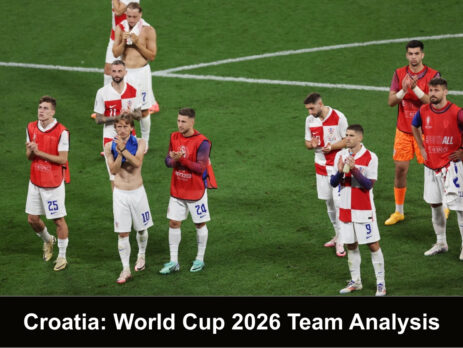
Croatia 2026 World Cup: Team Analysis, Roster Projection & Preview
Croatia enters the 2026 World Cup as one of Europe’s most respected and tactically disciplined national teams. Since their historic run to the 2018 final and their third-place finish in 2022, Croatia has firmly established itself among international football’s elite. Known for technical midfield excellence, defensive intelligence, and composure in high-pressure matches, Croatia continues to evolve while maintaining the identity that has defined its modern golden generation.
Under head coach Zlatko Dalić, Croatia has built a system centered on midfield control, structured defensive shape, and intelligent positional play. While veterans such as Luka Modrić continue to provide leadership, a new wave of talents including Joško Gvardiol and Luka Sučić is shaping the next chapter of Croatian football. This balance of experience and youth positions Croatia as a serious contender heading into the 2026 World Cup.
Tactical Foundation
Croatia’s tactical identity is rooted in technical superiority and game management.
Midfield dominance – Croatia’s system revolves around central control. Historically anchored by Luka Modrić, the midfield prioritizes ball retention, tempo regulation, and intelligent spatial awareness.
Structured defensive discipline – The Croatia National Team maintains compact defensive lines, limiting central penetration and forcing opponents wide. Their defensive approach emphasizes anticipation and positioning rather than physical aggression.
Positional intelligence – Players are tactically versatile and comfortable rotating positions, particularly in midfield triangles.
Controlled attacking transitions – Rather than relying purely on pace, Croatia builds patiently before accelerating through precise vertical passes.
Croatia most commonly operates in a 4-3-3 or 4-2-3-1 formation but can shift into a more conservative 4-1-4-1 against elite opposition.
Team Performance in the Last Year
Over the past 12–18 months, Croatia has continued competing at a high level in European competition and international fixtures. The squad has demonstrated consistency, tactical maturity, and the ability to manage matches against top-tier opponents.
Attack
Croatia’s attack blends creativity with intelligent movement.
Andrej Kramarić – Clinical forward capable of scoring in tight spaces.
Ivan Perišić – Experienced wide attacker with versatility and leadership.
Bruno Petković – Physical striker with strong hold-up play.
Luka Ivanušec – Creative wide option with technical ability.
Mario Pašalić – Midfield runner contributing goals from deep.
Croatia’s attacking patterns emphasize:
Short combination play in midfield
Overlapping full-back support
Late runs into the box
Set-piece precision
Defense
Defensively, Croatia remains organized and tactically disciplined.
Joško Gvardiol – Elite center-back known for composure and ball progression.
Domagoj Vida – Experienced defender with tournament pedigree.
Borna Sosa – Attack-minded left-back with strong delivery.
Josip Juranović – Energetic full-back with defensive reliability.
Goalkeeper Dominik Livaković has established himself as one of Europe’s most reliable international goalkeepers, particularly noted for composure in penalty situations and strong reflexes.
Overall, Croatia enters the 2026 World Cup cycle with tactical clarity and tournament experience.
Expected 2026 Croatia World Cup Roster
Goalkeepers
Dominik Livaković – Established No. 1 with elite shot-stopping. Ivo Grbić – Reliable backup with international experience. Nediljko Labrović – Emerging depth option.
Defenders
Joško Gvardiol – Defensive anchor and ball-playing leader. Domagoj Vida – Veteran presence. Josip Šutalo – Modern center-back with composure. Borna Sosa – Left-back with crossing quality. Josip Juranović – Consistent right-back. Josip Stanišić – Versatile defensive option. Martin Erlić – Rotational depth at center-back.
Midfielders
Luka Modrić – Legendary playmaker and leader. Marcelo Brozović – Deep-lying midfield controller. Mateo Kovačić – Press-resistant ball carrier. Luka Sučić – Rising creative talent. Mario Pašalić – Goal-scoring midfielder. Lovro Majer – Technical attacking midfielder.
Forwards / Attackers
Andrej Kramarić – Intelligent finisher. Ivan Perišić – Experienced wide attacker. Bruno Petković – Physical striker option. Luka Ivanušec – Creative winger. Marko Livaja – Strong central presence. Nikola Vlašić – Versatile attacking midfielder.
This projected roster reflects Croatia’s continued blend of elite midfield quality and defensive structure.
Players to Watch
Luka Modrić
The heartbeat of Croatian football. His vision, composure, and leadership remain central to the team’s structure.
Joško Gvardiol
One of the world’s top young defenders. His composure and ball progression elevate Croatia’s defensive system.
Mateo Kovačić
Provides dynamic ball-carrying and midfield stability.
Andrej Kramarić
A reliable goal scorer capable of decisive tournament moments.
Dominik Livaković
Proven goalkeeper in high-pressure knockout matches.
Projected Starting XI
Formation: 4-3-3
GK: Dominik Livaković
RB: Josip Juranović
CB: Joško Gvardiol
CB: Josip Šutalo
LB: Borna Sosa
CM: Marcelo Brozović
CM: Mateo Kovačić
CM: Luka Modrić
RW: Andrej Kramarić
LW: Ivan Perišić
ST: Bruno Petković
Croatia can also transition into a 4-2-3-1 depending on match demands.
Strengths and Weaknesses
Attack – Strengths: Technical finishing; intelligent movement; midfield service. Weaknesses: Can lack pace against high defensive lines.
Midfield – Strengths: Elite technical quality; possession control; composure. Weaknesses: Transition defense against rapid counters.
Defense – Strengths: Organized structure; world-class center-back presence. Weaknesses: Aging depth in certain positions.
Goalkeeping – Strengths: Experienced and composed under pressure. Weaknesses: Limited margin for error against elite finishing.
Tactics – Strengths: Tactical intelligence; adaptability; structured buildup. Weaknesses: Can struggle if forced into high-tempo chaos.
Mentality – Strengths: Tournament experience; composure in knockout rounds. Weaknesses: Managing generational transition.
Player Injury Status
Croatia’s core squad remains largely available entering the 2026 cycle. As with all elite European-based squads, player workload management will be important leading into tournament preparation. Depth options across midfield and defense provide flexibility should injuries arise.
Historical World Cup Performance
Croatia has become one of Europe’s most successful modern World Cup nations:
Runners-up in 2018
Third place in 2022
Third place in 1998
Their legacy includes:
Midfield excellence
Strong tournament composure
Consistent knockout-stage competitiveness
Outlook for the 2026 World Cup
Croatia enters the 2026 World Cup with elite tournament experience and continued midfield quality. With Luka Modrić providing leadership, Joško Gvardiol anchoring the defense, and a technically refined midfield core, Croatia remains one of Europe’s most tactically complete teams.
Group Stage Outlook: Croatia should be competitive in any group and is capable of advancing.
Knockout-Stage Potential: A quarterfinal appearance is realistic, with semifinal ambitions dependent on squad health and generational transition performance.