

 Mexico
 South Korea
 South Africa
 TBD
TBD Canada
 Switzerland
 Qatar
Qatar Brazil
 Morocco
 Scotland
 Haiti
Haiti USA
USA Paraguay
 Australia
 Germany
 Ecuador
 Ivory Coast
 Curaçao
 Netherlands
 Japan
Japan Tunisia
 Belgium
 Iran
Iran Egypt
Egypt New Zealand
 Spain
Spain Uruguay
 Saudi Arabia
 Cape Verde
 France
 Senegal
 Norway
 Argentina
 Austria
 Algeria
 Jordan
 Portugal
 Colombia
 Uzbekistan
 England
 Croatia
 Panama
 Ghana
Ghana

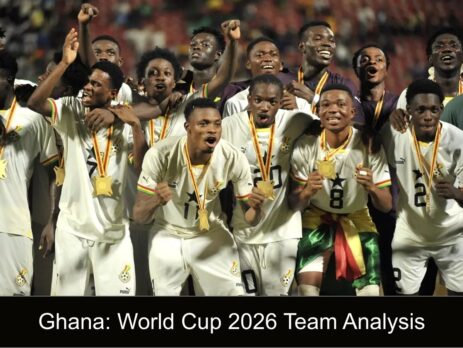
Ghana 2026 World Cup: Team Analysis, Roster Projection & Preview
Ghana enters the 2026 World Cup as one of Africa’s most historic and recognizable national teams. Known globally as the Black Stars, Ghana combines athleticism, technical midfield quality, and tournament experience to remain a formidable opponent on the international stage. With a strong core of Europe-based professionals and emerging young talents, Ghana continues to evolve under modern tactical systems while maintaining the competitive edge that has defined its World Cup legacy. Their consistent presence in major tournaments and competitive performances in CAF competitions reflect a nation capable of challenging top opposition.
Under the leadership of the current Ghana Football Association technical staff (final 2026 coaching appointment pending confirmation), Ghana has emphasized structured pressing, midfield control, and transitional speed. The squad blends experienced leaders such as Thomas Partey and Jordan Ayew with dynamic younger players like Mohammed Kudus and Antoine Semenyo. This mix of veteran composure and youthful attacking energy gives Ghana a balanced profile heading into the 2026 World Cup.
Tactical Foundation
Ghana’s tactical identity in recent international cycles has been built around athleticism, midfield strength, and rapid attacking transitions.
Midfield control and ball progression – Ghana’s system is heavily influenced by the presence of technically secure midfielders. With players such as Thomas Partey and Mohammed Kudus, Ghana is capable of progressing the ball through central areas while maintaining defensive structure behind it.
Transitional pace in attack – Ghana thrives when attacking quickly. Wide players and forwards are encouraged to exploit space immediately after regaining possession, allowing the Black Stars to create chances before opposing defenses reset.
Compact defensive structure – Ghana typically maintains defensive compactness in a 4-2-3-1 or 4-3-3 shape. Their defensive approach prioritizes positional awareness and collective tracking rather than relying solely on physical duels.
Flexible attacking roles – Mohammed Kudus often operates between midfield and attack, creating fluidity. Ghana’s system allows wide forwards to invert or stretch play depending on match dynamics.
Ghana’s tactical flexibility gives them multiple approaches depending on opponent strength, match state, and tournament context.
Team Performance in the Last Year
Over the past 12–18 months, Ghana has continued competing in CAF qualification cycles and international friendlies as part of preparations for the 2026 World Cup. Performances have reflected a team still refining its tactical consistency while demonstrating high-level individual quality.
Attack
Ghana’s attack increasingly revolves around Mohammed Kudus, whose creativity, dribbling ability, and composure in tight spaces make him central to the Black Stars’ offensive structure. Kudus provides scoring threat from midfield and the versatility to operate in multiple advanced roles.
Supporting Kudus is a dynamic group including:
Jordan Ayew – Experienced forward and key leader in high-pressure matches.
Antoine Semenyo – Direct attacker with pace and strength in transition.
Inaki Williams – Athletic striker who stretches defensive lines.
Kamaldeen Sulemana – Explosive winger capable of 1v1 dominance.
Ernest Nuamah – Emerging talent with strong attacking instincts.
Ghana’s attacking patterns emphasize:
Quick central combinations
Wide acceleration in transition
Late midfield runs into the box
Direct play when space opens behind the defense
Defense
Defensively, Ghana remains organized and athletic. Key contributors include:
Mohammed Salisu – Strong central defender with aerial presence.
Alexander Djiku – Experienced organizer with positional awareness.
Tariq Lamptey – Attack-minded full-back providing width and recovery speed.
Daniel Amartey – Versatile defensive option capable of multiple roles.
Goalkeeping duties are expected to rotate among experienced options, with Lawrence Ati-Zigi frequently trusted in recent competitive fixtures. His shot-stopping and composure provide stability in major matches.
Overall, Ghana enters the 2026 World Cup cycle with competitive depth, individual star quality, and tactical balance.
Expected 2026 Ghana World Cup Roster
Goalkeepers
Lawrence Ati-Zigi – Experienced international starter. Jojo Wollacott – Reliable depth option. Abdul Manaf Nurudeen – Young goalkeeper with long-term potential.
Defenders
Mohammed Salisu – Physical and composed center-back. Alexander Djiku – Defensive leader with strong awareness. Daniel Amartey – Versatile defender with tournament experience. Tariq Lamptey – Dynamic attacking full-back. Gideon Mensah – Left-back providing defensive balance. Alidu Seidu – Athletic defender with recovery speed. Kingsley Schindler – Wide defensive option.
Midfielders
Thomas Partey – Midfield anchor and leader. Mohammed Kudus – Creative engine and attacking focal point. Salis Abdul Samed – Defensive midfielder with strong ball recovery. Elisha Owusu – Tactical discipline and passing range. Majeed Ashimeru – Progressive passer. Ibrahim Sulemana – Young box-to-box option.
Forwards / Attackers
Jordan Ayew – Veteran presence and experience. Antoine Semenyo – Powerful transitional attacker. Inaki Williams – Direct striker with pace. Kamaldeen Sulemana – Explosive wide threat. Ernest Nuamah – Emerging attacking talent. Osman Bukari – Speed option off the bench.
This projected roster blends experience, European-based professionalism, and rising youth talent.
Players to Watch
Mohammed Kudus
The technical heartbeat of Ghana’s attack. His ability to carry the ball forward and create scoring opportunities makes him the most influential attacking player.
Thomas Partey
Provides composure, structure, and defensive stability in midfield. His leadership will be critical in high-intensity tournament matches.
Mohammed Salisu
Strong in aerial duels and positional defense. A key figure in maintaining defensive compactness.
Antoine Semenyo
Brings pace and physicality that suits Ghana’s transitional style.
Inaki Williams
A forward capable of stretching defenses and creating space for midfield runners.
Projected Starting XI
Formation: 4-2-3-1
GK: Lawrence Ati-Zigi
RB: Tariq Lamptey
CB: Mohammed Salisu
CB: Alexander Djiku
LB: Gideon Mensah
DM: Thomas Partey
CM: Salis Abdul Samed
RW: Antoine Semenyo
CAM: Mohammed Kudus
LW: Kamaldeen Sulemana
ST: Inaki Williams
Ghana can also shift into a 4-3-3 or a more compact 4-4-2 depending on match requirements.
Strengths and Weaknesses
Attack – Strengths: Explosive pace; strong dribblers; multiple scoring threats. Weaknesses: Can struggle breaking down deep defensive blocks.
Midfield – Strengths: Technical quality; ball progression; physical presence. Weaknesses: Depth consistency can fluctuate.
Defense – Strengths: Athletic center-backs; recovery speed. Weaknesses: Vulnerable to sustained wide pressure.
Goalkeeping – Strengths: Reliable shot-stopping. Weaknesses: Distribution under heavy press can be inconsistent.
Tactics – Strengths: Quick transitions; flexible attacking roles. Weaknesses: Can lose compactness during extended attacking phases.
Mentality – Strengths: Competitive spirit; tournament experience. Weaknesses: Maintaining composure in knockout pressure moments.
Player Injury Status
Ghana enters the 2026 cycle with most key players available, though club workloads and minor knocks are common throughout the season. Monitoring player fitness — particularly in midfield and wide attacking roles — will be important as tournament preparations intensify.
No confirmed long-term injuries currently impact the projected core squad.
Historical World Cup Performance
Ghana has established itself as one of Africa’s most competitive World Cup nations:
Quarterfinal appearance in 2010
Round-of-16 qualification in 2006
Multiple World Cup participations in the modern era
Their legacy includes:
Fearless performances against elite opponents
Strong athletic identity
Emergence of globally recognized players
Outlook for the 2026 World Cup
Ghana enters the 2026 World Cup with a balanced mix of experience and emerging talent. With Mohammed Kudus providing creativity, Thomas Partey anchoring midfield, and a dynamic forward line capable of exploiting space, the Black Stars have the tools to compete against top nations.
Group Stage Outlook: Ghana is capable of advancing from a balanced group, particularly if midfield control remains consistent.
Knockout-Stage Potential: A Round-of-16 appearance is realistic, with quarterfinal ambitions possible if tactical discipline and finishing efficiency align at the right moment.