

 Mexico
 South Korea
 South Africa
 TBD
TBD Canada
 Switzerland
 Qatar
Qatar Brazil
 Morocco
 Scotland
 Haiti
Haiti USA
USA Paraguay
 Australia
 Germany
 Ecuador
 Ivory Coast
 Curaçao
 Netherlands
 Japan
Japan Tunisia
 Belgium
 Iran
Iran Egypt
Egypt New Zealand
 Spain
Spain Uruguay
 Saudi Arabia
 Cape Verde
 France
 Senegal
 Norway
 Argentina
 Austria
 Algeria
 Jordan
 Portugal
 Colombia
 Uzbekistan
 England
 Croatia
 Panama
 Ghana
Ghana

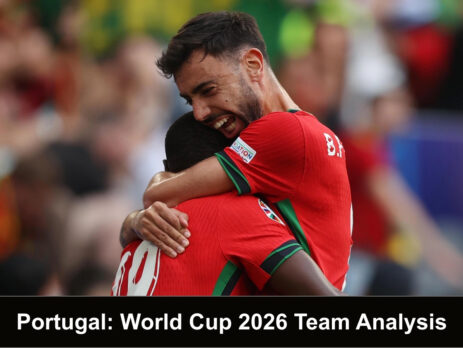
Portugal 2026 World Cup: Team Analysis, Roster Projection & Preview
Portugal enters the 2026 World Cup as one of Europe’s most technically gifted and tactically balanced national teams. After winning UEFA Euro 2016 and consistently advancing deep into major tournaments over the past decade, Portugal remains firmly among international football’s elite. With a blend of experienced leaders and a new generation of highly skilled attacking players, the Seleção continues to evolve while maintaining a structured and possession-oriented identity.
Under head coach Roberto Martínez, Portugal has emphasized controlled buildup play, midfield technical quality, and attacking fluidity. While veteran leader Cristiano Ronaldo continues to provide experience and goal-scoring presence, the squad increasingly revolves around dynamic talents such as Bruno Fernandes, Bernardo Silva, and Rafael Leão. This balance of leadership and youthful explosiveness positions Portugal as a serious contender heading into the 2026 World Cup.
Tactical Foundation
Portugal’s tactical identity centers on possession control and intelligent positional play.
Technical midfield dominance – Portugal prioritizes ball retention through technically elite midfielders capable of operating in tight spaces. Quick combinations and progressive passing allow them to control tempo.
Wide attacking creativity – The Seleção consistently utilizes wingers who can isolate defenders and cut inside to create scoring opportunities.
Structured defensive organization – Portugal maintains compact lines and disciplined spacing, limiting central penetration and forcing opponents into wide areas.
Formation flexibility – Portugal typically operates in a 4-3-3 or 4-2-3-1 but has shown the ability to transition into a back-three system depending on match demands.
This tactical flexibility allows Portugal to adapt effectively to both possession-heavy opponents and transition-focused teams.
Team Performance in the Last Year
Over the past 12–18 months, Portugal has continued to compete strongly in European competition and international fixtures. The squad has demonstrated depth, technical superiority, and consistent attacking output.
Attack
Portugal’s attack remains one of the most dynamic in international football.
Cristiano Ronaldo – Legendary forward and experienced leader.
Bruno Fernandes – Creative hub with goal-scoring and assist capability.
Bernardo Silva – Intelligent wide playmaker with high work rate.
Rafael Leão – Explosive winger capable of breaking defensive lines.
Gonçalo Ramos – Emerging striker with strong finishing instincts.
Portugal’s attacking patterns emphasize:
Quick short-passing sequences
Wide isolation and inverted winger play
Overlapping full-back support
Midfield runners arriving late into the box
Defense
Defensively, Portugal blends experience with emerging talent.
Rúben Dias – Defensive leader with elite positional awareness.
Pepe – Veteran center-back with tournament experience.
João Cancelo – Attack-minded full-back with technical versatility.
Nuno Mendes – Dynamic left-back providing pace and width.
Goalkeeper Diogo Costa has established himself as Portugal’s primary option, offering strong distribution and reflexes in high-pressure situations.
Overall, Portugal enters the 2026 cycle with a balanced squad capable of controlling matches through both possession and transition.
Expected 2026 Portugal World Cup Roster
Goalkeepers
Diogo Costa – Established starter with strong distribution. José Sá – Experienced backup option. Rui Patrício – Veteran goalkeeper with tournament pedigree.
Defenders
Rúben Dias – Defensive anchor and leader. Pepe – Experienced center-back. Gonçalo Inácio – Ball-playing defender. João Cancelo – Versatile full-back. Nuno Mendes – Pace-driven left-back. Diogo Dalot – Reliable wide defender. António Silva – Emerging central defensive talent.
Midfielders
Bruno Fernandes – Creative leader and attacking engine. Bernardo Silva – Intelligent playmaker with tactical discipline. Vitinha – Technical midfielder with strong passing range. João Palhinha – Defensive midfield presence. Rúben Neves – Deep-lying playmaker. Otávio – Energetic midfield option.
Forwards / Attackers
Cristiano Ronaldo – Historic goal scorer and leader. Rafael Leão – Explosive wide attacker. Gonçalo Ramos – Clinical central striker. João Félix – Creative attacking option. Pedro Neto – Direct winger with pace. Diogo Jota – Versatile forward with goal-scoring ability.
This projected roster reflects Portugal’s depth across all positions and tactical versatility.
Players to Watch
Bruno Fernandes
The creative engine of Portugal’s midfield. His passing range and scoring ability are central to the team’s attacking success.
Rúben Dias
Defensive leader whose composure and positioning stabilize the back line.
Rafael Leão
Explosive winger capable of decisive moments against compact defenses.
Diogo Costa
Modern goalkeeper with distribution skills suited to Portugal’s buildup play.
Bernardo Silva
Intelligent and versatile attacker whose work rate enhances Portugal’s structure.
Projected Starting XI
Formation: 4-3-3
GK: Diogo Costa
RB: João Cancelo
CB: Rúben Dias
CB: Gonçalo Inácio
LB: Nuno Mendes
CM: João Palhinha
CM: Bruno Fernandes
CM: Bernardo Silva
RW: Pedro Neto
LW: Rafael Leão
ST: Gonçalo Ramos
Portugal can also shift into a 4-2-3-1 with Bruno Fernandes in an advanced central role or a 3-4-3 against elite competition.
Strengths and Weaknesses
Attack – Strengths: Technical creativity; wide explosiveness; elite finishing options. Weaknesses: Can over-rely on possession against deep defensive blocks.
Midfield – Strengths: High technical quality; intelligent positioning. Weaknesses: Transition vulnerability if possession is lost centrally.
Defense – Strengths: Experienced center-backs; tactical organization. Weaknesses: Aging depth in certain defensive roles.
Goalkeeping – Strengths: Modern distribution; composure under pressure. Weaknesses: Limited margin for error against elite finishing.
Tactics – Strengths: Formation flexibility; possession dominance; structured buildup. Weaknesses: Can struggle if forced into chaotic high-tempo matches.
Mentality – Strengths: Tournament experience; leadership presence. Weaknesses: Managing generational transition dynamics.
Player Injury Status
Portugal’s projected core remains largely available entering the 2026 cycle. As with many European-based squads, managing club workload will be essential. Depth in midfield and wide attacking roles provides coverage should injuries occur before tournament selection.
Historical World Cup Performance
Portugal’s World Cup history includes:
Third place in 1966
Fourth place in 2006
Multiple knockout-stage appearances in the modern era
Their legacy includes:
Technical excellence
Elite attacking talent
Consistent European competitiveness
Outlook for the 2026 World Cup
Portugal enters the 2026 World Cup with technical depth, tactical intelligence, and attacking versatility. With Bruno Fernandes orchestrating play, Rúben Dias anchoring the defense, and dynamic wide options stretching opponents, Portugal possesses the tools to compete with the world’s best.
Group Stage Outlook: Portugal is expected to compete strongly in any group and should aim to advance.
Knockout-Stage Potential: A quarterfinal appearance is realistic, with semifinal ambitions dependent on tactical consistency and squad health.